Walk through GMR Aerocity on any given evening and you will feel it before you can name it: the particular restlessness of a place built entirely for movement. Escalators carrying people who are already late. Glass towers that reflect each other back and forth until the whole district feels like a hall of mirrors built for luggage trolleys. It is not a place designed to make you stop.
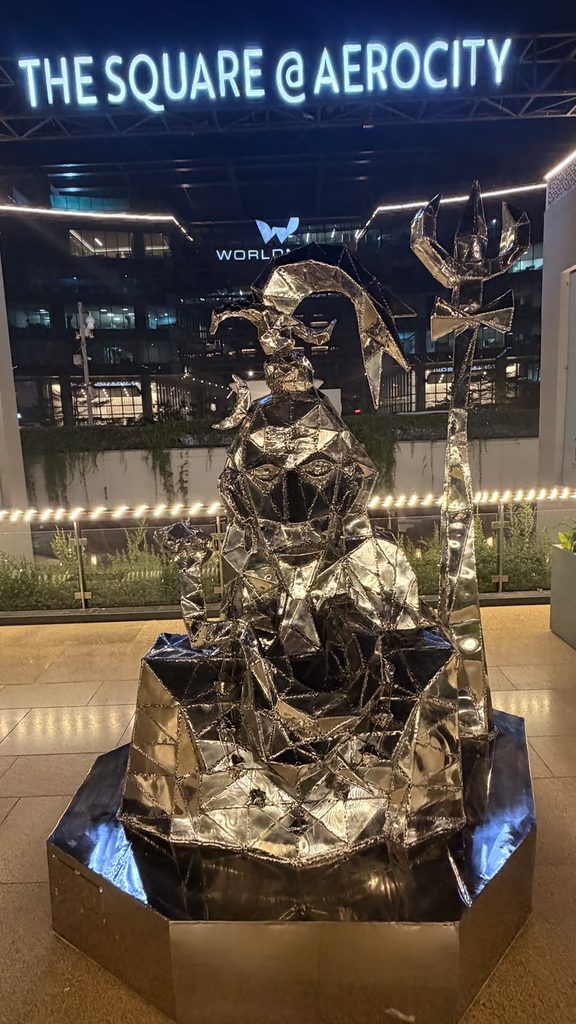
Which is what makes Vikash Kalra’s steel sculptures, set down right in the middle of all that motion, such an odd and welcome interruption.
Steel, in the body, might as well be the heart. It doesn’t rest. It labours in the background on its own schedule, a pure force of repetition, beating and beating long after we’ve stopped paying it any attention, indifferent to whether we’re ready or not. The mind is a different material altogether, not a muscle working to its own rhythm, but a surface that shows us back whatever experience has just thrown at it, unedited and usually fractured, rarely the single clean image we’d prefer to see of ourselves. Kalra’s sculptures feel like an attempt to hold both of those states in one object: steel as the body’s quiet, tireless labour, and the fractured, mirrored surface as the mind, a raw and unflattering reflection of everything we’ve just lived through.
It’s worth setting this against Jeff Koons here, since he is probably the artist most people think of first when they hear “mirror-polished steel sculpture.” Koons’ stainless steel pieces, the Balloon Dogs, the Rabbit, are built for the opposite effect: one continuous, flawless, mirror-smooth surface that gives you back a single unbroken reflection, playful and perfect, closer to spectacle than to self-examination. Kalra’s steel refuses that smoothness. It breaks the reflection into dozens of separate planes that don’t quite agree with each other, so instead of a single polished image of yourself, you get yourself in pieces, and have to do the work of putting that back together. Where Koons’ surfaces flatter, Kalra’s ask something of you.
That fracturing is also, I think, the whole point of choosing Ganesha and Shiva as subjects here. These aren’t safe, decorative renderings of familiar gods. The forms are angular, geometric, closer to something out of an architect’s model than a temple. Set against the hypermodern rhythm of an airport district, that choice makes sense. If the sacred is going to reach anyone in a place like this, it can’t wait for people to come looking for it in a temple. It has to meet them on the way to their gate.
None of this claims steel can replace slower, older traditions of carving and casting. But it’s worth noticing what it offers instead. In a city that keeps building faster than it can reflect on what it’s building, there’s something quietly useful about an object that just stands there, fractured and reflective, waiting for someone hurrying past to catch their own face in it for half a second longer than they meant to.
That pause is small. But in a place built entirely to move you through it as efficiently as possible, small might be exactly the right size.